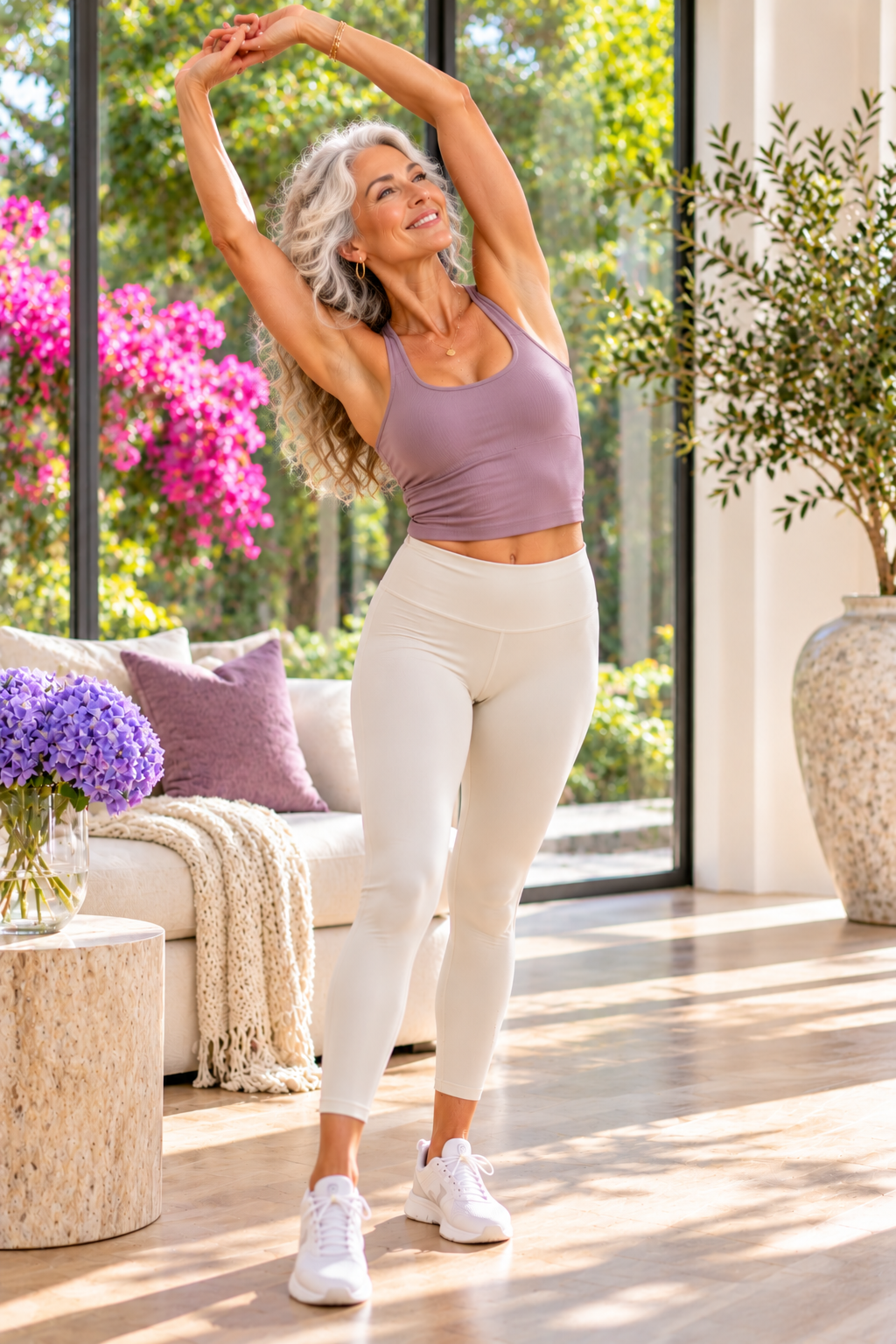
There is something wonderfully simple about stretching.
No expensive equipment. No complicated routine. No need to change into workout clothes or set aside an entire hour.
Just a few moments to move your body through positions it may not have experienced all day.
Perhaps it's the satisfying stretch you take after waking up, reaching your arms overhead and lengthening your spine.
Or the relief of standing after spending hours at a desk.
Maybe it's the gentle pull through your calves after a long walk, or the pleasure of opening your shoulders after a day spent looking down at your phone.
These small movements can feel remarkably good.
Yet stretching is often treated as an afterthought—something we do before or after exercise, if we remember at all.
But stretching deserves consideration as a practice of its own.
Not because everyone needs to become more flexible, but because maintaining comfortable movement is one of the quiet advantages of taking care of your body.
Flexibility Is About More Than Touching Your Toes
When we think about flexibility, we often picture gymnasts, dancers, or someone effortlessly folding themselves into an impressive yoga pose.
But everyday flexibility is much less dramatic.
It's the ability to reach overhead without feeling unusually restricted.
To turn comfortably when looking behind you.
To bend toward your shoes.
To move your arms and legs through the ranges of motion that daily life requires.
Flexibility describes how far a joint can move, while mobility also involves your ability to control movement through that range.
Both matter, but they aren't interchangeable.
Stretching primarily helps improve or maintain flexibility. Strength and movement practice also contribute to the mobility we use throughout the day.
You don't need extraordinary flexibility to live comfortably.
You simply want enough movement available to do the things you enjoy.
Why Your Body Can Begin to Feel Stiffer
Have you ever stood up after a long afternoon at your desk and felt as though your body needed a moment to remember how to move?
That familiar stiffness doesn't necessarily mean anything is wrong.
Spending extended periods in the same position can make movement feel temporarily restricted.
Your hips have been bent.
Your knees haven't moved much.
Your shoulders may have remained in a narrow range of motion.
And when you finally stand, your body welcomes a change.
Age can also influence flexibility, although the amount of change varies considerably from person to person.
Physical activity, previous injuries, joint conditions, muscle strength, and individual anatomy all contribute to how comfortably we move.
Stretching isn't a way to stop aging.
But it can be one useful part of maintaining flexibility throughout life.
And perhaps more importantly, it gives you an opportunity to notice where your body feels comfortable—and where it may benefit from a little more attention.
What Regular Stretching Can Actually Do
The most established benefit of stretching is improving flexibility and joint range of motion.
With regular practice, muscles and surrounding tissues can become more tolerant of movement into longer positions, allowing you to move through a greater range.
That may make certain everyday activities feel easier, particularly when limited flexibility has been getting in the way.
Stretching can also be a pleasant way to transition between activities.
A few gentle movements after sitting.
A comfortable stretch after exercise.
A short routine before bed.
These moments can help you reconnect with how your body feels.
But it's worth understanding what stretching doesn't necessarily do.
Research hasn't consistently shown that stretching before or after exercise prevents ordinary post-workout muscle soreness. Evidence that stretching alone prevents injuries is also limited and depends on the activity and context.
And although stretching may feel relaxing, it shouldn't be presented as a cure for chronic pain.
Its value doesn't need to be exaggerated.
Improving flexibility and making movement feel more comfortable are worthwhile benefits on their own.
Dynamic Stretching vs. Static Stretching: What's the Difference?
Not all stretching looks the same.
Two common approaches are dynamic stretching and static stretching, and each has a useful place in an active lifestyle.
Dynamic Stretching: Movement That Prepares You to Move
Dynamic stretching involves controlled, repeated movements that take your joints through a comfortable range of motion.
Think of gentle arm circles.
Marching in place.
Leg swings.
Or rotating your shoulders and upper body.
Rather than holding one position, you're moving continuously.
Dynamic stretching can be particularly useful before physical activity because it helps prepare your body for the movements you're about to perform.
For example, before a walk, you might begin with marching in place, ankle movements, and a few comfortable leg swings.
The goal isn't to stretch as far as possible.
It's to move smoothly and gradually.
Static Stretching: Slowing Down and Holding a Position
Static stretching involves moving into a comfortable stretch and holding it for a period of time.
You might gently stretch your calf against a wall.
Lengthen the front of your thigh.
Or bring one arm across your chest to stretch your shoulder.
Static stretching is often especially convenient after exercise or as a separate flexibility routine, when your muscles are already warm.
For most adults, holding a comfortable stretch for approximately 10–30 seconds is a practical starting point.
The sensation should be noticeable but not painful.
You don't need to force the position or bounce to make it effective.
Stretching and Strength Work Beautifully Together
It's tempting to think of stretching and strength training as opposite activities.
One lengthens.
The other strengthens.
But your body benefits from both.
Stretching helps maintain or improve the range of motion available to your joints.
Strength training helps develop the muscular capacity to control movement and handle physical demands.
And resistance training performed through an appropriate range of motion can itself improve flexibility.
This is why stretching shouldn't replace strength training—or vice versa.
A balanced routine can include both, along with aerobic activity and exercises that challenge balance and coordination.
The goal isn't simply to move farther.
It's to move comfortably, confidently, and with control.
A Simple Five-Minute Daily Stretching Routine
You don't need an elaborate stretching program to begin.
This short routine offers an approachable way to give several commonly restricted areas of your body a little attention.
It's designed for generally healthy adults who can stand comfortably and move without significant pain. Use a sturdy chair or wall for support whenever needed.
<text_placeholder />
1. Shoulder and Upper-Back Stretch — 1 Minute
Stand or sit tall.
Bring your right arm gently across the front of your chest.
Use your left hand to support the arm, drawing it slightly closer without forcing it.
Hold for 30 seconds.
Switch sides and repeat.
Keep your shoulders relaxed and breathe normally.
Why it helps: Encourages flexibility around the shoulders, an area that can feel restricted after prolonged sitting or desk work.
2. Standing Calf Stretch — 1 Minute
Stand facing a wall and place your hands against it for support.
Step your right foot behind you.
Keep your back heel on the floor and gently bend your front knee until you feel a comfortable stretch in the back calf.
Hold for 30 seconds.
Switch legs and repeat.
Why it helps: Maintains flexibility in the calf muscles, which contribute to comfortable ankle movement during walking and other activities.
3. Gentle Standing Hip-Flexor Stretch — 1 Minute
Stand beside a sturdy chair or counter for balance.
Step your right foot backward into a short, comfortable staggered stance.
Keep your torso upright and gently shift your pelvis forward until you feel a mild stretch at the front of your right hip.
Avoid arching your lower back.
Hold for 30 seconds.
Switch sides and repeat.
Why it helps: Targets the muscles at the front of the hips, which remain in a shortened position when we're sitting.
4. Seated Hamstring Stretch — 1 Minute
Sit near the front of a sturdy chair.
Extend your right leg forward with your heel resting on the floor and your knee comfortably straight.
Keep your back long and hinge slightly forward from your hips until you feel a gentle stretch along the back of your thigh.
Hold for 30 seconds.
Switch legs and repeat.
Why it helps: Encourages flexibility in the hamstrings, which influence how comfortably you can bend at the hips.
5. Gentle Chest-Opening Stretch — 1 Minute
Stand tall with your arms resting comfortably by your sides.
Bring your hands slightly behind your hips, with your palms facing forward.
Gently draw your shoulders back and allow your chest to open without lifting your chin or arching your lower back.
Hold for 20–30 seconds, release, and repeat.
Why it helps: Encourages movement through the chest and front of the shoulders after activities that keep your arms positioned in front of your body.
A gentle reminder: Warm up with a few minutes of easy walking or marching before static stretching, especially first thing in the morning. Stretch only to mild tension, never pain. If you have an injury, joint replacement, osteoporosis, balance difficulties, or another condition affecting movement, ask a qualified healthcare professional which stretches are appropriate.
How Often Should You Stretch?
Consistency matters more than creating an elaborate routine.
The American College of Sports Medicine generally recommends flexibility exercise at least two or three days per week, with daily stretching potentially offering additional flexibility benefits.
That doesn't mean you need a lengthy session every day.
You might spend a few minutes stretching after your morning walk.
Add several movements after a strength-training session.
Or set aside a little time in the evening.
A brief routine can be a useful starting point, although longer or repeated holds may be needed to make substantial flexibility improvements.
The most useful schedule is one you can maintain comfortably.
Common Stretching Mistakes Worth Avoiding
Stretching may look simple, but a few habits can make it less comfortable or less effective.
Stretching cold muscles aggressively. Gentle movement first can make static stretching more comfortable.
Bouncing into a stretch. For ordinary static stretching, slow, controlled movements are generally preferable.
Pushing through pain. A stretch should produce mild tension, not sharp pain, tingling, or numbness.
Holding your breath. Relaxed, natural breathing helps you avoid unnecessary tension.
Trying to match someone else's flexibility. Your anatomy, history, and current range of motion are individual.
Expecting immediate dramatic results. Improvements in flexibility generally develop through repeated practice.
Stretching isn't a competition.
And the deepest stretch isn't necessarily the best one.
Make Stretching Part of Something You Already Do
One of the easiest ways to establish a new habit is to connect it with something familiar.
Stretch your calves after your daily walk.
Open your shoulders after finishing work.
Do a few comfortable movements after gardening.
Spend five minutes stretching while listening to music in the evening.
You can even keep a sturdy chair nearby and make stretching part of your regular routine at home.
The objective isn't to add another complicated task to your day.
It's to make comfortable movement a little more accessible.
Over time, those small moments can become something you look forward to.
The Freedom to Move Comfortably
There is a certain luxury in being able to move through your day without giving every movement a second thought.
Reaching.
Turning.
Bending.
Walking.
Getting up from a chair.
Enjoying the activities that make life interesting.
Stretching alone can't guarantee that freedom. Strength, balance, joint health, and regular physical activity all play important roles.
But maintaining flexibility is one piece of the picture.
And it's a piece that doesn't necessarily require much equipment, expense, or preparation.
You don't need to become extraordinarily flexible.
You don't need to master complicated poses.
You don't need to measure your progress against anyone else.
You simply need to give your body opportunities to move.
Because taking care of your flexibility isn't about how far you can stretch today. It's about helping yourself continue to move comfortably through the years ahead.
