The Japanese Art of Forest Bathing
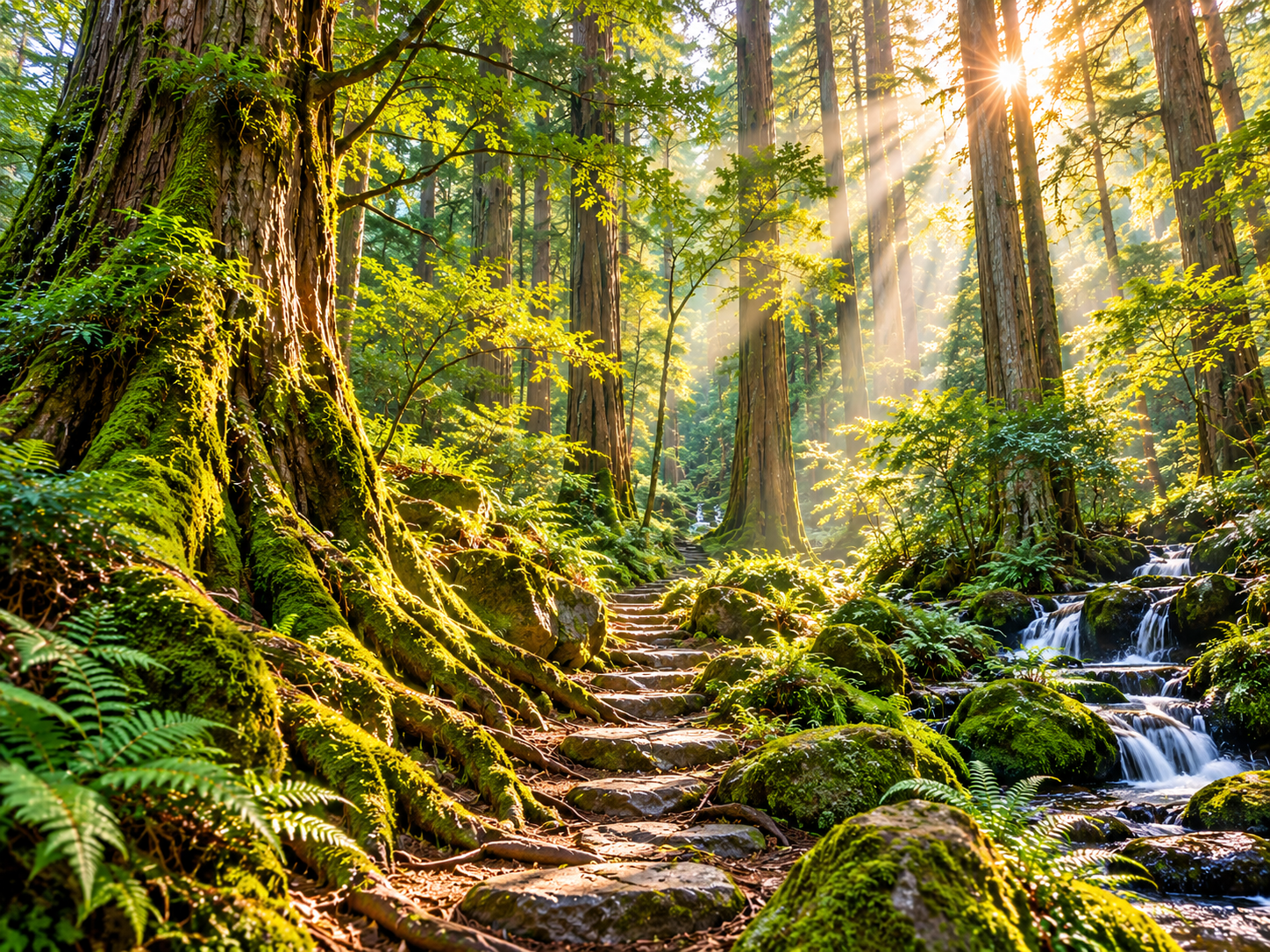
Discover shinrin-yoku, the Japanese practice of immersing yourself in the atmosphere of a forest—and the extraordinary beauty of experiencing nature through all your senses.
Imagine stepping into a Japanese forest just after a gentle rain.
The air is cool and fragrant. Moss covers the stones beneath towering trees, and the sunlight filters through layers of brilliant green leaves.
Somewhere nearby, water moves over rocks.
You follow a narrow woodland path, but there is no particular destination. No summit to reach. No distance to complete.
You stop beside an ancient tree and look upward, following its trunk into a canopy that seems to disappear into the sky.
For a moment, there is nothing to accomplish.
There is only the forest.
In Japan, this kind of experience has a name: shinrin-yoku, often translated as forest bathing.
And despite what the name might suggest, no water is required.
What Is Shinrin-Yoku?
The Japanese word shinrin means forest, while yoku means bathing.
Together, they describe the experience of immersing yourself in the atmosphere of a forest.
Rather than focusing on exercise, distance, or reaching a destination, forest bathing invites you to experience the natural environment through your senses.
The movement might be slow. There may be frequent pauses. Sometimes the most memorable moments happen while standing completely still.
You notice the scent of damp earth.
The shifting patterns of sunlight.
The sound of leaves moving overhead.
The remarkable variety of greens surrounding you.
Although people in Japan have appreciated forests for centuries, the term shinrin-yoku was formally introduced by Japan's Forestry Agency in 1982 as a way of encouraging people to enjoy and connect with forest environments.
What began as a Japanese approach to enjoying forests has since attracted international interest.
And its appeal extends well beyond Japan.
A Different Way to Experience a Forest
Most of us are familiar with the idea of taking a walk in the woods.
Forest bathing introduces a subtle but interesting difference.
A hike often has a purpose. There may be a particular trail, a destination, a viewpoint, or a physical challenge.
With shinrin-yoku, the experience itself becomes the purpose.
Imagine two people entering the same forest.
One walks briskly along the trail, checking the distance traveled and hoping to reach a scenic overlook before lunch.
The other pauses to examine a patch of moss, listens to birds calling from the canopy, and notices how the temperature changes beneath the trees.
Neither experience is wrong.
They are simply different ways of enjoying the same landscape.
Forest bathing places particular value on the second.
It creates an opportunity to notice things that are easily missed when we're concentrating on getting somewhere.
The shape of a leaf.
The scent of cedar.
The texture of bark.
The changing sound of footsteps on a woodland path.
Small details become part of the experience rather than background scenery.
Why Japanese Forests Are So Extraordinary
Japan offers an astonishing variety of forest landscapes.
There are ancient cedar forests, mist-covered mountain woodlands, magnificent cypress groves, and lush subtropical environments where moss and ferns seem to cover almost every available surface.
Some forests are deeply connected to Japanese cultural and spiritual traditions. Others have become celebrated destinations for visitors interested in nature, walking, and forest bathing.
Two places are especially fascinating.
Akasawa Natural Recreational Forest — Nagano
In the mountains of Nagano Prefecture, the Akasawa Natural Recreational Forest is renowned for its magnificent Kiso hinoki cypress trees, some more than 300 years old.
Protected since the early Edo period, this beautiful forest is closely associated with the development of modern shinrin-yoku.
Its walking paths pass beneath towering trees, through fragrant woodland, and alongside the quiet beauty of the Kiso Valley.
The experience is not necessarily about venturing deep into wilderness.
Visitors can explore designated trails, appreciate the historic forest, and even experience a heritage forest railway.
Akasawa offers a particularly beautiful example of how a forest can be appreciated as a destination in its own right.
Not simply somewhere to pass through, but somewhere worth spending time.
Yakushima Island — Kagoshima
Farther south, the island of Yakushima offers an entirely different forest experience.
This UNESCO World Heritage destination is famous for its ancient Japanese cedar trees, extraordinary biodiversity, abundant rainfall, and lush, moss-covered landscapes.
Some of its celebrated yakusugi cedars are more than a thousand years old.
Imagine walking through a forest where enormous roots twist across the earth, moss blankets fallen branches, and mist drifts between ancient trunks.
The landscape feels almost prehistoric.
One of Yakushima's most captivating destinations is Shiratani Unsuikyo Ravine, where forest paths wind through richly green woodland and remarkable moss-covered scenery.
It's the kind of place that makes you wonder how many generations have passed beneath the same trees.
And perhaps that sense of time is part of its appeal.
A forest can remind us that the world is much older, larger, and more intricate than our daily routines sometimes allow us to notice.
What Science Is Discovering About Forest Bathing
The appeal of forests is not limited to their beauty.
Researchers have also become interested in how spending time in forest environments may influence psychological and physical well-being.
Studies have examined changes in mood, perceived stress, anxiety, blood pressure, heart rate, and other indicators.
A 2023 systematic review and meta-analysis involving 36 studies and more than 3,500 participants found that forest bathing was associated with improvements in symptoms of anxiety and depression.
More recent research has also reported promising results for psychological stress and certain short-term physiological measures.
The findings are encouraging, although researchers continue to investigate how large and lasting these effects may be. Study quality varies, and forest bathing should not be regarded as a substitute for medical treatment.
Still, the research raises an intriguing question.
What is it about forests that can make spending time among trees feel so different from spending time in a busy urban environment?
There may not be one simple answer.
The sounds, scents, natural light, physical movement, reduced demands on attention, and experience of being surrounded by greenery may all contribute.
And perhaps one of the most interesting aspects is that we can enjoy the experience without needing to understand every mechanism behind it.
The Extraordinary Sensory World of a Forest
Part of the beauty of shinrin-yoku lies in how much there is to experience when we begin paying attention.
The Scent of the Trees
Forests have distinctive fragrances.
Cypress, cedar, pine, damp soil, leaves, and woodland flowers create a constantly changing atmosphere.
Trees also release natural volatile compounds, including substances known as phytoncides, which researchers have studied as one possible part of the forest environment's effects on people.
But long before anyone began measuring these compounds, people could appreciate the unmistakable pleasure of breathing fresh woodland air.
The Sound of the Forest
A forest is rarely completely silent.
There may be birdsong, insects, moving water, wind, or the gentle rustle of branches overhead.
Unlike the mechanical repetition of traffic or machinery, these natural sounds often change in delicate, unpredictable ways.
They give the forest its own atmosphere.
The Beauty of Filtered Light
One of the most captivating features of a forest is the way sunlight moves through the canopy.
In Japan, the word komorebi is used to describe sunlight filtering through the leaves of trees.
It is a beautiful word for an equally beautiful experience.
The patterns shift with the wind, creating moments of brightness and shadow that never remain exactly the same.
Sometimes an entire forest path seems illuminated by this moving light.
The Feeling of Being Surrounded by Life
A forest is a living environment.
Even when everything appears still, there is activity everywhere.
Leaves are growing. Water is moving through the soil. Fungi are interacting with roots. Birds and insects are carrying on with their lives.
There is something extraordinary about standing within such a complex natural world.
And simply noticing it can change the way we experience the place.
What a Forest Bathing Experience Might Look Like
Imagine visiting a beautiful forest without planning to cover a particular distance.
You choose a comfortable path and begin walking.
After a few minutes, something catches your attention: perhaps the shape of an old tree or the sound of a stream.
You stop.
You notice the air.
You listen.
You follow the movement of sunlight across the ground.
Perhaps you sit for a while.
Perhaps you continue walking until something else invites you to pause.
There is no special equipment required beyond what makes the outing comfortable and safe. There is no perfect amount of time, no required pace, and no particular feeling you're supposed to achieve.
A guided forest bathing experience may introduce invitations to engage with different senses, but the essential idea remains wonderfully accessible.
The forest is not a task to complete.
It's a place to experience.
A Beautiful Tradition That Travels Beyond Japan
One of the loveliest aspects of shinrin-yoku is that its underlying experience is not limited to a particular country.
Japan gave this approach a name and helped introduce it to a wider audience.
But the pleasure of spending unhurried time among trees can be found in forests around the world.
A woodland in England.
A redwood grove in California.
A mountain forest in Canada.
A quiet nature preserve just beyond the city.
Each has its own sounds, fragrances, colors, and character.
And while few places can recreate the extraordinary atmosphere of Japan's ancient forests, they can offer something equally meaningful: the chance to become more familiar with the natural world immediately around us.
Perhaps the most beautiful lesson of forest bathing is not that we need to find the perfect forest.
It's that a forest may have much more to offer than we notice when we're in a hurry.
The Beauty of Going Nowhere in Particular
There is something wonderfully unusual about an experience that doesn't ask us to accomplish anything.
No destination.
No performance.
No finish line.
Just a pathway beneath the trees and the possibility of discovering something beautiful along the way.
Perhaps it's an extraordinary landscape you traveled halfway around the world to see.
Or perhaps it's a familiar woodland that suddenly feels different because you've given yourself time to notice it.
Either way, the experience can stay with you long after you've left the trees behind.
If you could spend an unhurried afternoon in any forest in the world, where would you go—and what would you most love to experience there?
Explore Further
Japan's Forestry Agency — The Art of Forest Bathing — The Japanese agency's introduction to shinrin-yoku and its origins.
Discover Forest Bathing in Nagano — Japan National Tourism Organization — Explore the historic cypress forests of Akasawa.
Akasawa Natural Recreational Forest — Japan's Local Treasures — Discover the forest's history, trails, and natural beauty.
Yakushima Island — Japan National Tourism Organization — Explore one of Japan's most extraordinary ancient forest landscapes.
The Science of Forest Bathing — Research Review — A closer look at research on forest bathing and psychological well-being.
