From ancient thermal baths to wild hot springs, exploring our enduring desire to soak, slow down, and seek restoration in water.
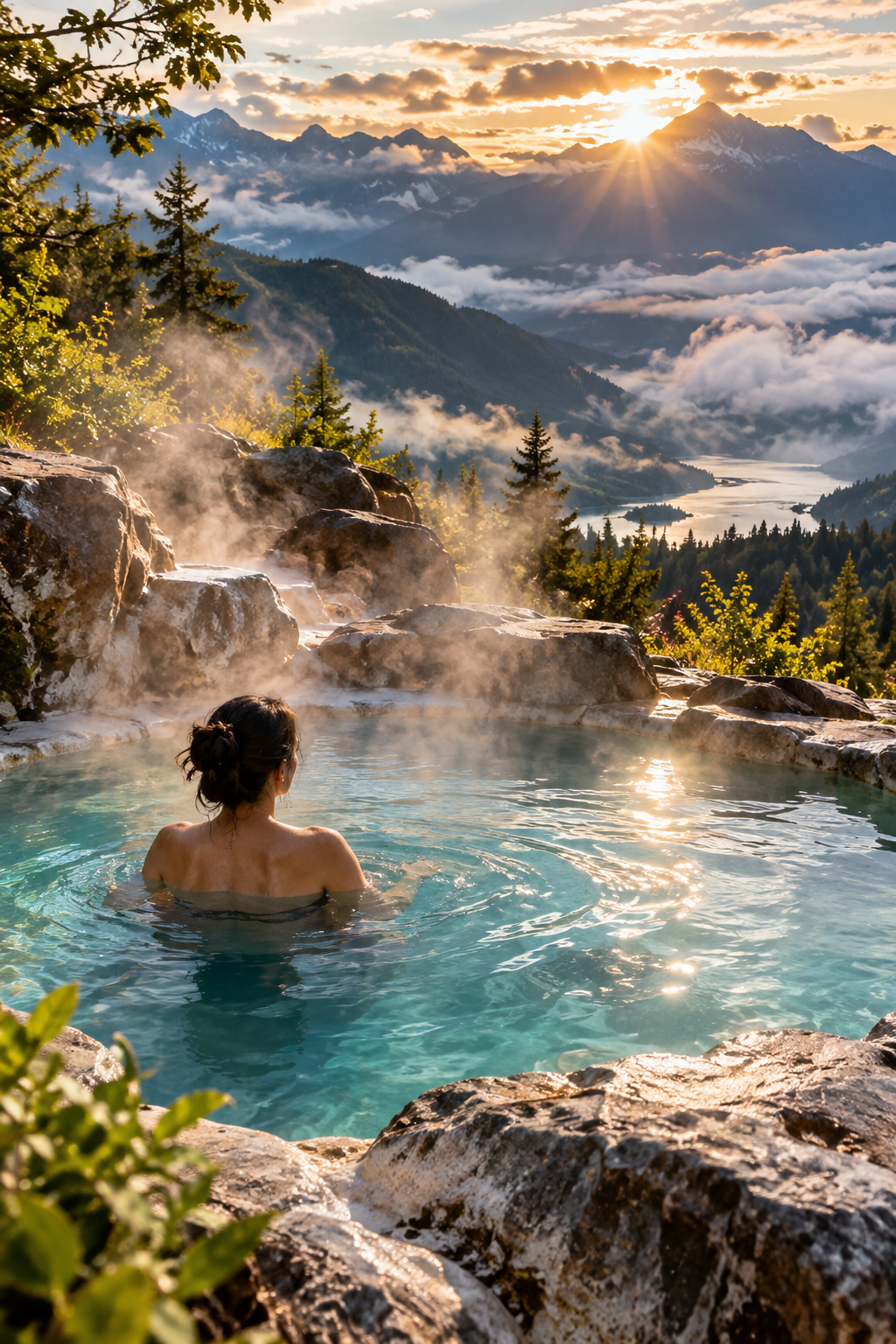
There is something almost irresistible about steam rising from water in the middle of a beautiful landscape.
Maybe it is a turquoise pool tucked between mountains. A centuries-old bathhouse. A stone basin overlooking a forest. Or a spring discovered at the end of a winding trail, where warm water seems to emerge impossibly from the earth itself.
Long before the modern wellness retreat, people were gathering around naturally heated waters.
Across places and generations, we have returned to them—to bathe, to gather, to rest, and sometimes simply to disappear beneath the surface for a little while.
What is it about these waters that continues to call us back?
Perhaps the answer isn't one thing at all.
Water Warmed by the Earth
A natural hot spring begins far below what we can see.
Water travels underground, where it is heated by the Earth before finding its way back toward the surface. Along the way, it can interact with surrounding rock and minerals, giving different springs remarkably different characteristics.
Some waters are crystal clear. Others appear milky, turquoise, blue or rust-colored. Some carry the unmistakable scent of sulfur. Some emerge into carefully constructed bathing pools, while others spill between rocks with little evidence that people have touched them at all.
Perhaps that unpredictability is part of their appeal.
A natural hot spring isn't simply warm water.
It belongs to the landscape.
We Have Been Seeking These Waters for a Very Long Time
The desire to soak in naturally warm water is hardly a modern wellness trend.
Bathing traditions developed in cultures around the world, becoming intertwined in different places with community, hospitality, spirituality, medicine and everyday life.
Japan offers one of the most enduring examples. Its volcanic geography has produced thousands of hot-spring sources, and onsen bathing has become deeply woven into Japanese culture. Some hot-spring communities have histories stretching back centuries.
There is also a traditional Japanese practice known as toji, historically associated with extended stays at hot-spring areas. Rather than arriving for a quick soak and immediately leaving, people might stay for days or longer.
And there is something interesting about that idea.
You went somewhere.
You stayed.
You soaked.
You ate.
You rested.
And then you did it again.
Perhaps our modern interpretation of restoration sometimes overlooks that part.
Maybe It Isn't Only the Water
Imagine two experiences.
In the first, you take a quick hot shower while thinking about everything you need to accomplish that day.
In the second, you're sitting in warm water outdoors. Steam drifts past your face. The air is cool. Mountains rise in the distance. There is nowhere you need to be for the next hour.
Both involve warm water.
But they are hardly the same experience.
Hot springs often come bundled with many of the things we associate with slowing down: nature, warmth, quiet, distance from routine, fewer distractions and the deliberate decision to stop doing something for a while.
That makes it difficult—and perhaps unnecessary—to separate every part of the experience.
Maybe the restorative feeling comes from the warmth.
Maybe it comes from the setting.
Maybe it is simply the permission to stop.
Most likely, the experience is a combination of many things.

by Mamaraya
What Does the Science Say?
There is genuine scientific interest in thermal bathing and balneotherapy, a term commonly used for therapeutic bathing in mineral or thermal waters.
Researchers have studied thermal mineral bathing in connection with a number of health conditions, particularly musculoskeletal and dermatological conditions. Some research suggests potential benefits in certain circumstances, although the evidence varies considerably by condition, treatment and type of water.
That's an important distinction.
The fact that a spring contains minerals does not automatically make it a treatment, and one hot spring can have a very different mineral composition from another.
There is also a much simpler observation that may matter just as much to most of us:
Warm water can simply feel wonderful.
And sometimes an experience doesn't need to promise a cure to be worth having.
The Beauty of Doing Almost Nothing
There aren't many experiences in modern life where doing nothing is the entire point.
A hot spring is one of them.
You aren't trying to reach the other side of the pool.
You aren't counting repetitions.
You aren't accomplishing anything.
You lower yourself into the water and stay there.
Perhaps you watch steam disappear into cold air. Listen to water moving over stone. Notice the landscape. Talk quietly with someone beside you. Or simply close your eyes.
There is no productivity requirement.
And perhaps that's part of what makes the experience feel so different.
The Waters Are Different Everywhere
One of the most beautiful things about thermal bathing is that there isn't a single version of it.
In Japan, an outdoor rotenburo might overlook mountains or forest.
Elsewhere, geothermal water may collect in an undeveloped pool surrounded by rock and wilderness.
Some thermal destinations have evolved into elaborate historic bathhouses. Others remain remarkably simple.
The water itself varies, too—temperature, color, mineral composition, surroundings and even the way a bathing experience is approached can change from one place to another.
So perhaps seeking restorative waters isn't really about finding the best hot spring.
It may be about discovering the experience that speaks to you.
Would you choose a secluded spring reached by trail?
An elegant historic bathhouse?
A steaming pool surrounded by snow?
A quiet outdoor bath overlooking a forest?
Or somewhere completely unexpected?
The answer probably says something about what restoration looks like to you.
A Little Respect for Wild Water
Natural doesn't automatically mean risk-free.
Hot springs can reach dangerously high temperatures, conditions in undeveloped geothermal areas can change, and established destinations may have their own safety guidance.
Naturally hot freshwater also carries some uncommon but potentially serious risks. The CDC advises avoiding getting water up the nose when swimming or soaking in naturally hot freshwater because Naegleria fowleri, a rare amoeba that can cause a devastating infection, can live in warm freshwater.
Culture deserves respect as well.
At a Japanese onsen, for example, bathing customs traditionally include thoroughly washing before entering the communal bath. Learning the etiquette of the place is part of experiencing it thoughtfully.
Seeking beautiful places doesn't mean treating them as though they exist solely for us.
Sometimes living well also means being a good guest.
In Search of Your Own Restorative Waters
Perhaps you've already experienced a place like this.
A hot spring you still remember.
A lake at sunrise.
An outdoor bath overlooking somewhere beautiful.
Or perhaps your version of restorative water isn't geothermal at all.
That may be the more interesting question:
What kind of water makes you want to stay a little longer?
Maybe it is warm.
Maybe it is wild.
Maybe it comes with mountains, architecture, history or complete silence.
We have been seeking restorative waters for centuries.
But the water that feels restorative to you may be yours to discover.
Explore Further
Japan National Tourism Organization — Onsen & Hot Springs
Hot Springs in Japan / Onsen Guide
An introduction to Japanese onsen culture, hot-spring experiences and bathing traditions.
Japan National Tourism Organization — Hot-Spring Culture & Toji
The Unique Hot-Spring Culture of Towada-Hachimantai National Park
Further exploration of traditional hot-spring stays and bathing culture in Japan.
