Why Open Spaces Make Us Feel Free
The Powerful Effect of Wide Horizons, Expansive Views, and Room to See
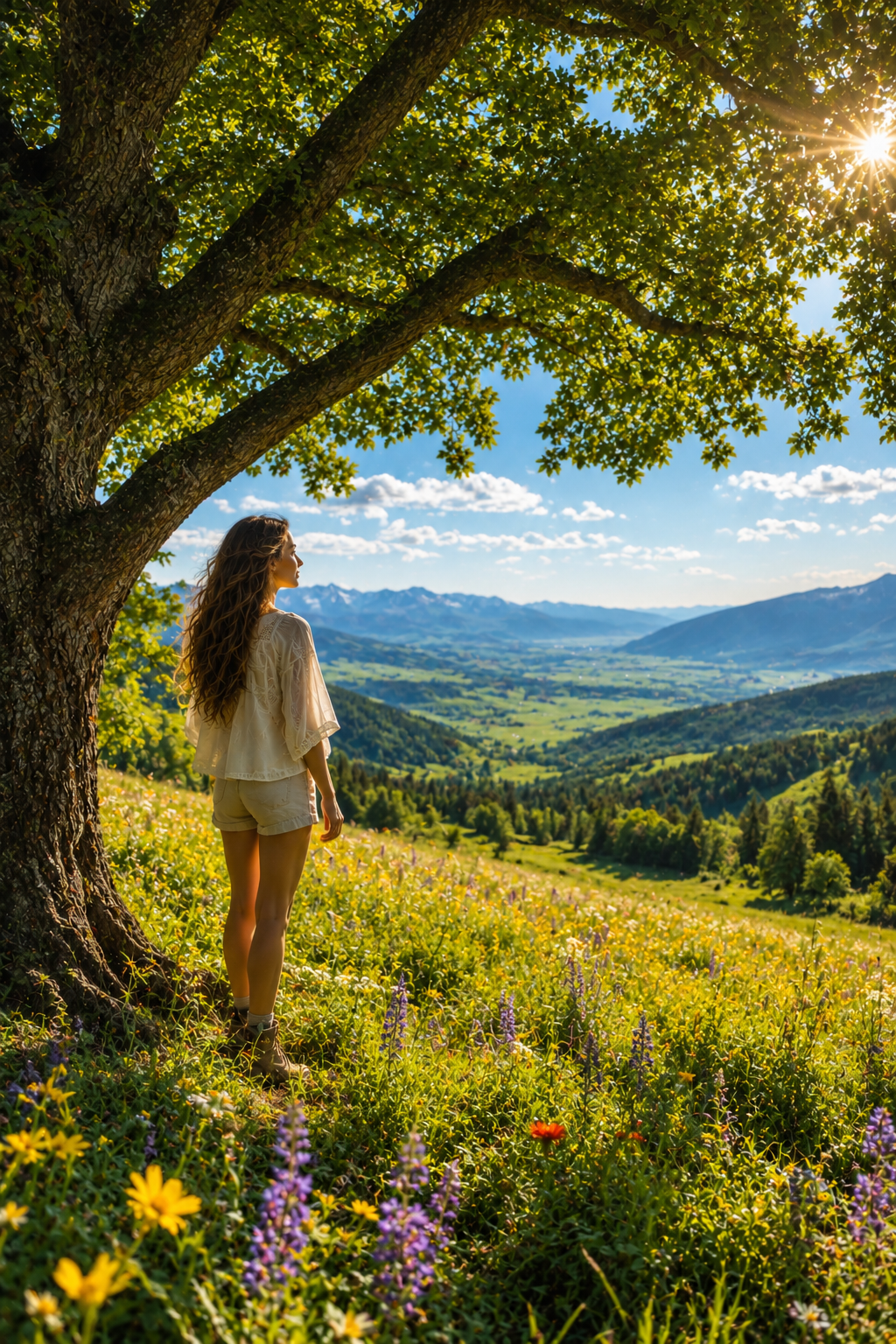
There is a particular feeling that comes from standing somewhere you can see for miles.
At the edge of the ocean.
On a mountain overlook.
Across an open desert.
In the middle of a sweeping meadow.
Suddenly, there is room.
Room to look farther.
Room to breathe.
Room for your attention to expand beyond whatever was occupying it a few moments earlier.
We often describe that feeling as freedom.
But what is it about open spaces that creates such a powerful response?
The answer may have as much to do with how we perceive our surroundings as with the beauty of the landscape itself.
Our Eyes Finally Have Somewhere to Go
Much of modern life happens at close range.
Walls.
Screens.
Cars.
Hallways.
Buildings.
Even in busy outdoor environments, our visual field is frequently interrupted by signs, structures, traffic, and other people.
Then we arrive somewhere expansive and suddenly our eyes can travel.
Across a valley.
Toward a distant mountain.
Along an uninterrupted coastline.
Into a seemingly endless sky.
That change in visual scale can feel remarkably refreshing.
Instead of constantly shifting our attention among objects close to us, we are able to look outward and into the distance.
Sometimes simply seeing farther seems to create a sense of having more room ourselves.
The Psychology of Prospect
Environmental psychology offers an interesting explanation for some of our attraction to expansive views.
One idea known as prospect-refuge theory suggests that people tend to appreciate environments that provide opportunities to see what surrounds them while also offering some sense of shelter or security.
Think about some of the places people naturally gravitate toward:
A bench overlooking the ocean.
A shaded terrace with a mountain view.
A campsite at the edge of a clearing.
A hilltop beneath a large tree.
We seem to enjoy being able to see outward while still feeling comfortably situated within the landscape.
It's an intriguing balance:
shelter behind us, possibility ahead.
And it may help explain why certain views feel instantly appealing.
Wide Horizons Change Perspective
There is something humbling about looking across an enormous landscape.
Problems that felt consuming indoors can temporarily occupy a little less space.
The situation hasn't changed.
But our perspective has.
A wide horizon reminds us that there is a world beyond the immediate moment.
There are places we haven't visited.
Things we haven't experienced.
Days that haven't happened yet.
Perhaps that's part of what we interpret as freedom.
For a moment, life feels larger than whatever has been holding our attention.
Open Spaces Invite Possibility
There is a reason open roads and distant horizons have become symbols of freedom.
They visually suggest somewhere to go.
A dense environment tells the eye where the boundaries are.
An expansive landscape leaves the boundaries less obvious.
The ocean continues toward the horizon.
A trail disappears into distant hills.
The desert seems to stretch forever.
A meadow opens toward the sky.
Even when we're standing completely still, the landscape suggests movement and possibility.
There is something ahead.
Nature Gives Us Different Kinds of Space
Open space doesn't always mean standing on top of a mountain.
We can experience expansiveness in many forms.
The enormous horizontal line of the ocean.
The seemingly endless sky above a desert.
A lake surrounded by distant mountains.
Rolling farmland.
A field of tall grass.
A broad river valley.
A quiet beach at low tide.
Each creates a slightly different experience, but they share something important:
distance.
They give our eyes somewhere beyond the immediate environment to rest.
The Opposite Comfort of Trees
Interestingly, this doesn't mean enclosed natural environments are less appealing.
They simply offer something different.
A forest canopy can make us feel protected.
An open landscape can make us feel free.
One surrounds us.
The other expands around us.
And some of the most beautiful natural environments offer both.
Imagine standing beneath a large tree at the edge of a meadow, looking toward distant mountains.
You have shelter nearby and openness ahead.
Perhaps part of our attraction to nature comes from its ability to give us both experiences whenever we need them.
Awe Makes the World Feel Bigger
Some open landscapes do more than feel spacious.
They inspire awe.
Standing beneath an enormous sky or looking across a canyon can briefly shift our attention away from ourselves.
The scale is simply too large to ignore.
Researchers studying awe have found that experiences of vastness can alter our perception of ourselves and our surroundings, sometimes creating a sense of being part of something much larger.
That doesn't require spirituality or any particular belief.
Sometimes a mountain is simply so enormous, an ocean so vast, or a sky so spectacular that our attention naturally expands to meet it.
You Don't Have to Travel Far
Expansiveness isn't reserved for dramatic destinations.
Sometimes it's available much closer to home.
A neighborhood hill.
An uncrowded park.
A rooftop view.
A nearby lake.
A long stretch of trail.
An open field.
Even stepping outside and looking toward a broad evening sky can create a small version of the same experience.
The landscape doesn't have to be extraordinary.
Sometimes we simply need somewhere our eyes can travel.
A Wider View
Perhaps open spaces make us feel free because they temporarily remove some of the boundaries we spend our days navigating.
They give us distance.
Perspective.
Possibility.
A longer view.
They remind us that beyond the room we're sitting in, the screen we're looking at, or the concern occupying our thoughts, there is still an enormous world unfolding.
Sometimes freedom isn't about going anywhere at all.
Sometimes it's simply the feeling that comes when you look out and realize just how much space is still ahead of you.
Warmly,
Tamara