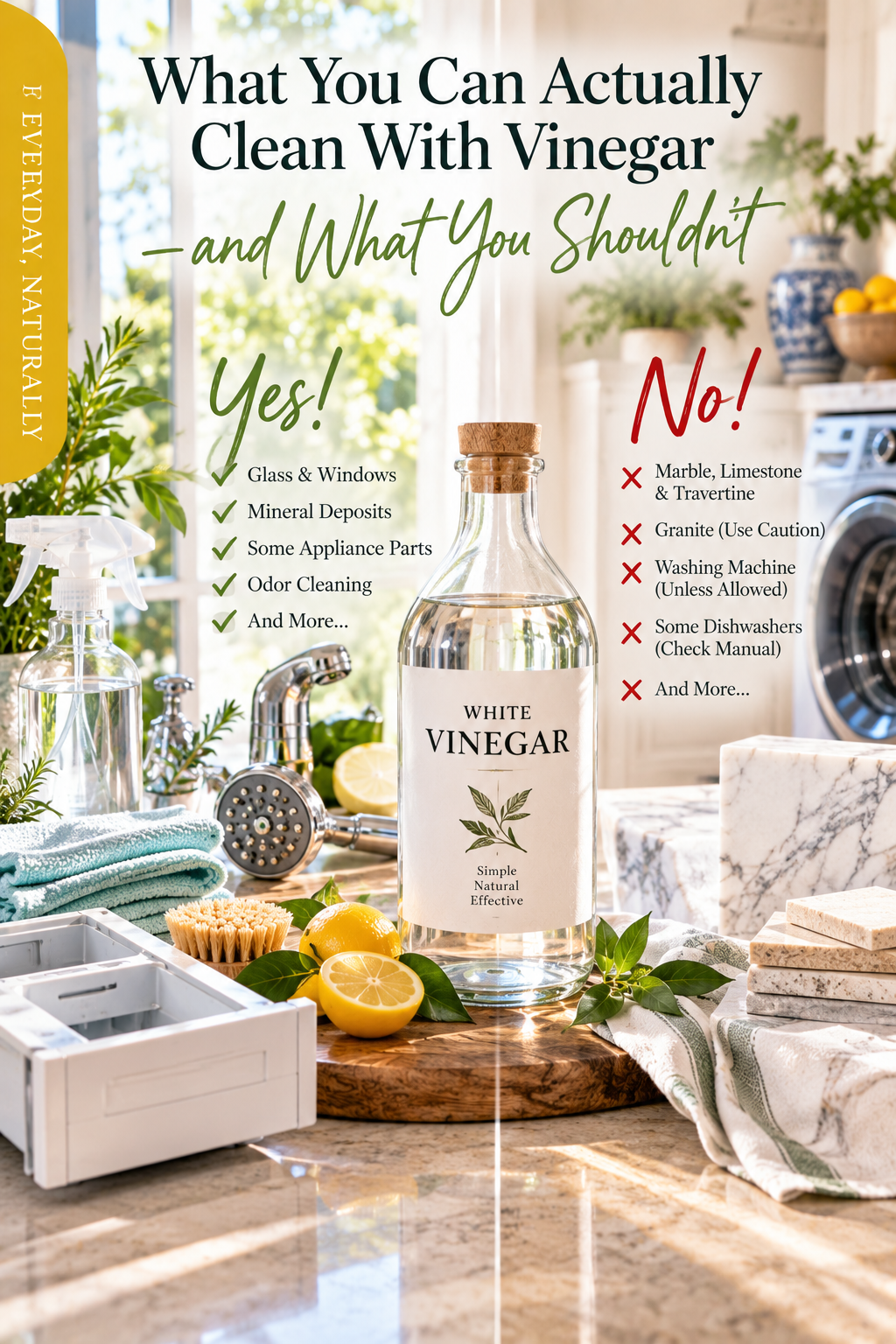
White vinegar has earned a permanent place in the natural-cleaning cupboard—and for good reason.
It's inexpensive, readily available, useful for dissolving mineral deposits, and surprisingly effective for certain everyday cleaning jobs.
But somewhere along the way, vinegar became known as the natural cleaner you can use on practically everything.
You can't.
Vinegar is acidic. That's precisely why it works so well for some jobs—and precisely why it can damage certain surfaces and materials.
So rather than asking, “What can I clean naturally with vinegar?” there's a better question:
Is vinegar appropriate for what I'm cleaning?
Here are some places where it can be wonderfully useful—and others where it's better left in the bottle.
YES: Glass and Many Windows
For ordinary grime and streaks, diluted white vinegar can be useful on plain glass.
A simple mixture of vinegar and water applied to a microfiber cloth can help cut through fingerprints and residue. Then buff the glass dry with a clean cloth.
But remember that not everything that looks like ordinary glass necessarily is. Specialty coatings, films and tinted windows can have their own care requirements, so check the manufacturer's instructions first.
YES: Mineral Deposits on Some Fixtures
This is one of vinegar's strengths.
The acid can help loosen the chalky mineral buildup left behind by hard water on compatible faucets, showerheads and other fixtures.
For a removable showerhead, soaking the appropriate parts in diluted vinegar can make stubborn mineral deposits easier to remove.
But check the finish first. Specialty finishes and plated surfaces may have cleaning restrictions.
Natural doesn't automatically mean surface-safe.
YES: Some Removable Appliance Parts
Vinegar can sometimes be useful for removable parts that have accumulated mineral or detergent residue.
For example, Whirlpool says removable washing-machine dispenser drawers can be soaked in equal parts vinegar and water, scrubbed, thoroughly rinsed and dried.
The important word here is removable.
Using vinegar on an appropriate part outside an appliance isn't the same as pouring vinegar into the appliance itself.
YES: Certain Everyday Odor-Cleaning Jobs
Diluted vinegar can be useful when cleaning some compatible nonporous surfaces where lingering food or household odors are the problem.
The vinegar smell itself generally dissipates as it dries.
But there's an important distinction: cleaning isn't necessarily disinfecting.
If you need to disinfect a surface because of illness, raw-meat contamination or another higher-risk situation, use a product and method appropriate for that purpose rather than assuming a homemade vinegar spray is a substitute.
Where Vinegar Doesn't Belong
This half of the list may actually save you more money than the first half.
NO: Marble, Limestone or Travertine
This one deserves a giant NO.
These stones contain calcium carbonate, which is sensitive to acids. Vinegar can dull or etch the surface.
The Natural Stone Institute recommends neutral cleaners, stone soap or mild dish detergent and warm water for routine natural-stone cleaning, and specifically warns that vinegar and other acidic products can etch calcareous stones.
That beautiful marble bathroom?
Keep the vinegar away.
BE CAREFUL: Granite and Other Natural Stone
You may have heard that vinegar is perfectly safe for granite.
That's too broad a rule.
Some granites are more acid-resistant than marble, but the Natural Stone Institute notes that particular minerals—and sealers or treatments applied to the stone—can still be affected by acidic cleaners. Its guidance recommends non-acidic products for routine stone care.
If you don't know exactly what your countertop is made of or how it has been treated, vinegar isn't worth the experiment.
NO: Your Washing Machine Unless the Manufacturer Says Otherwise
This surprised me, because putting vinegar directly into a washing machine has become such common household advice.
Whirlpool specifically advises against it in its machines, explaining that repeated exposure to vinegar's acidity can damage components such as rubber seals and hoses over time.
Other manufacturers and models may give different instructions.
So for appliances, the owner's manual wins over the internet hack.
MAYBE: Your Dishwasher
This is a great example of why blanket rules don't work.
Whirlpool actually provides instructions for occasionally using white vinegar to deep-clean certain dishwashers—but also cautions that because vinegar is acidic, using it too frequently could damage the machine.
So rather than adopting “clean your dishwasher with vinegar” as a universal natural-living rule:
Check the instructions for your particular dishwasher.
NO: Anything Whose Manufacturer Says “No Acidic Cleaners”
This sounds obvious, but it may be the most useful rule in this entire article.
Modern homes contain coatings, finishes, sealants, adhesives, plastics, rubber components and engineered materials that aren't always obvious from looking at them.
If the care instructions say:
pH neutral cleaner only
or
Do not use acidic cleaners
vinegar isn't an exception simply because it's natural.
And Never Mix Vinegar With Bleach
This isn't a cleaning preference. It's a safety issue.
Never mix vinegar with chlorine bleach.
Adding an acid such as vinegar to bleach can release dangerous chlorine gas. Whirlpool explicitly warns against combining the two.
It's also a good general habit not to improvise combinations of household cleaning chemicals. More ingredients don't necessarily create a better cleaner.
The Better Natural-Cleaning Rule
Vinegar doesn't need to clean everything to be useful.
That's really the point.
Natural living isn't about replacing one bottle of commercial all-purpose cleaner with one bottle of vinegar and using it everywhere.
It's about understanding what you actually need for the job.
Sometimes that's vinegar.
Sometimes it's a little mild soap and warm water.
Sometimes it's a microfiber cloth.
And sometimes a particular surface or appliance needs the product its manufacturer recommends.
The simplest rule to remember?
Use vinegar because its acidity is useful—not simply because it's natural.

Outdoor Play by Joyreal
